
About the Semantic Eye
Semantics is a subfield of linguistics and philosophy that studies meaning in language — in written and other forms. The semantics of an expression such as a symbol, word, language fragment, gesture, etc. are what the expression actually means and what effects it causes in given contexts. Different contexts, languages, cultures and even people assign different meanings to one and the same expression. Words have multiple differing meanings; «bank», «date» or «sanction»1, 2, 3 are the usual suspects, but beware of the heinous «customer», «account», «product», etc.4
Confusion and misunderstandings between people mostly root in vague or differing semantics, or in both. People have different understandings of the seemingly same «thing». Such discrepancies can take months to uncover. They are a cause for much waste and frustration, and they can seriously hamper projects.
This is why transparent, precise and aligned semantics merit our full attention.
The Semantic Eye
The initiative is named Semantic Eye for its defining curious mindset and its focus on precision and correctness, for which proper and aligned semantics are an important component.
A semantics-aware mind develops a «semantic eye» that
- looks and obvserves carefully;
- discerns true meanings (semantics) of things;
- understands actual causes and effects;
- closely examines context and goals before jumping to conclusions or premature action.
The Semantic Eye Framework
However, just looking at the world with a different pair of eyes is not actually improving the situation for organisations in need of digital transformation. What organisations actually need are tangible results through practical, actionable advice and empowering tools (see also The Role of Tools).
This is what the Semantic Eye Framework has been developed for.
The Semantic Eye Framework 1.0 focuses on organisations, their subject areas and organisational processes. Future release may extend support to other fields of digitalisation.
The Semantic Eye and its framework are an initiative by d-puzzle. Get their professional guidance and support for your project over at www.d-puzzle.ch.
About the Logo
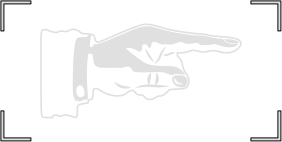
In case you're wondering why the logo of the Semantic Eye is not an eye, then be warned that it is not a hand either. The pun harkens back to the famous 1929 painting by René Magritte called La trahison des images (The treachery of images) showing a realistically-painted smoking pipe and the words:
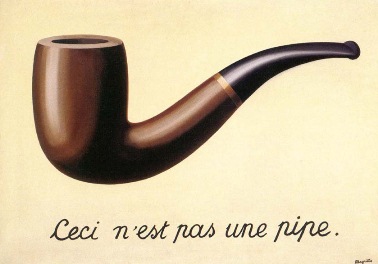
The painting caused a lot of controversy because it shows a pipe and at the same time claims, «this is not a pipe». Of course, Magritte is right — what he painted is an image of a pipe. He delivered the proof as a question: «Can I smoke it?»
So, looking at the Semantic Eye logo with an actual «semantic eye» (see above) let's you see it for what it is: a framed picture of a hand whose index finger points to the right.
Such pictures of hands are called manicules, and they have been understood and used for almost a thousand years as pointing to something noteworthy [6], [7]. Thus, the Semantic Eye logo points practitioners to the Semantic Eye Framework, which provides them with effective tools and teaches them to look at complex problems from a different angle, allowing them to get a deeper understanding and to create a meanignful and correct big picture (among other things).
1 bank: a piece of furniture, vs. river edge vs. financial institution vs. to tilt (an airplane)
2 date: romantic outing vs. a calendar day vs. a fruit
3 sanction: to approve or to penalize (which are actually opposites!)
4 team members can talk about «the customer» for months before they come to the realisation that the customer does not exist but rather has multiple faces that need to be defined and treated as different roles of a person, e.g. as prospect, buyer and maintenance contact, respectively