Need for Digitalisation
Organisations need digital trans-formations to ensure and improve the productivity, quality and innovation of their products and services — and of themselves as an organisation.

The Engineering Toolbox for effective Analysis, Design, Evolution and
Digitalisation of your Organisation and its Processes.
Too often, digital transformations of organisations and their processes cannot meet essential goals. Some even turn into an existential threat for the organisation. And they always take much longer, cost much more, wear out and frustrate staff, partners and customers.
Why should organisations do it anyway — and how can they avoid pitfalls?

Organisations need digital trans-formations to ensure and improve the productivity, quality and innovation of their products and services — and of themselves as an organisation.

A digital transformation is one of the most challenging things an organisation will ever do.
It will forever change that organisation to its core.

Digital transformation is a
high-risk endeavor
This is sadly evidenced by too many stumbling or entirely failing transformation projects.
Obviously, organisations want to avoid stepping into a sinkhole.
Just how?

The Semantic Eye Framework leads organisations to transformation success.
It greatly reduces transformation risks through its
– strong methodology
– effective guidance
– powerful digital tools
– best practises.
The Semantic Eye Framework digitalises the digital transformation of organisations.
We respect your time, so let's ensure you will get good mileage out of this page!

– fails to meet essential goals,
– was grossly underestimated,
– is in planning / about to start;

– improve the collaboration of people in processes, or
– enable people in getting their work done better or faster ...

the Semantic Eye Framework is
exactly what you need.
ELSE ...
the Semantic Eye might still tickle your digitalisation mind.
In short, wherever humans collaborate through tasks and activities to achieve goals, typically assited by software or machines,, the Semantic Eye Framework makes collaborations and processes understandable, understood and future-proof.
Why is it so hard for organisations to create their products and provide their services with digital support and automation? After all, other industries have been using digital tools with great success for a long time (e.g. Construction, Manufacturing, Logistics, Medicine).
Here are the top 3 reasons why organisation are struggling or failing in their digital transformations:
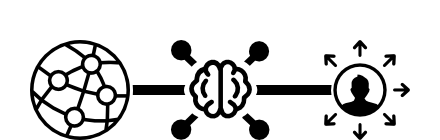
A digital transformation is an exercise in massive complexity over many dimensions.
It is very «easy» to overlook or misjudge important facts and dependencies. Often with disastrous consequences.

Digitalisation is automation, and automation is hard in any industry.
Digitalisation is also innovation, and innovation requires a rare combination of skills: knowledge, creativity and pragmatism.

Digital transformation is a young industry; current methodology is amateurish[5].
No truly digital tools are being used before actual software development starts.
(See section further down)
Today, organisations have no real grip on these monumental challenges.
Being aware of the risks and problems of a digital transformation, organisations seek help from IT partners. This often creates an unholy alliance where «the blind is leading the blind».Invariably, it leads to domain specialists becoming forever dependent on specific software people — who usually move on after a few year and are no longer available.

Organisations try to offload the truly staggering complexity of their own domain to a digital-solution partner.

The technology partner cannot handle organisational complexity either but takes the challenge anyway.
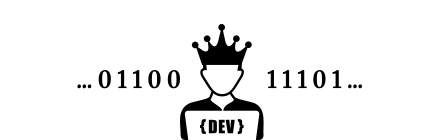
With the technology partner in the lead, the «game» is played on technology turf and with a
fixation on software code.
The outcome is exactly what organisations should avoid: all critical domain knowledge ends up in the software code that only its developers fully understand.
This is not a technical necessity, it is a serious governance problem.
Let's illustrate what this actually means in relation to e.g. Building Contstruction. While building architects have been using such wonderful tools as CAD or BIM since the 1970s, professionals who digitalise organisational processes continue to use the digital equivalents of pencils and paper.
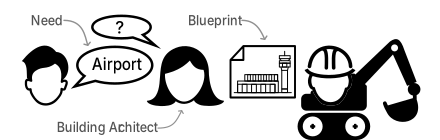
The future building owner talks to an architect. The architect knows how buildings and builders work. She draws true-to-scale blueprints and hands them to the builders.
The blueprints act as a precise, shared language.
The builders execute what the blueprints describe.
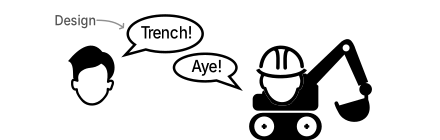
Especially in projects with agile methodologies, the future product owner («building owner») talks directly to the software developer («excavator guy»).
There is no shared language.
There are no solution blueprints.
«A bit more to the right, deeper ... deeper — that's it!»
A construction blueprint is a conceptual, shared model of the future building.
It is a binding contract (specification) for all involved parties.
Today, the digital transformation of organisations and their processes follows an outdated narrative that other, digitally more successful industries turned on its head decades or even centuries ago.
We need to fundamentally change the nature of digital transformation in four key areas:

... accepting that transformations are inevitably chaotic, more complex and more expensive than planned ...

... makes the transformation predictable by using digital tools to create two aligned solution models: one for the present, one for the future.
The actual transformation is the delta between present and future.
... the organisation starting the transformation by choosing a technology partner who then leads the transformation ...
... takes full responsibility for
its digital future.
First, it creates a solid
shared view of the future.
Next, it evaluates and chooses its technology platforms and technology partners.
Then it leads its own transformation.
... the organisation gathering requirements and throwing them over the fence for the technology partner to find a solution ...
... turns the requirements into a detailed, aligned semantic solution model.
It makes that model the contract (specification) with the technology partner.
... the organisation and the technology partner designing individual software features together ...
... defines coherent end-to-end processes, which become the units of realisation.
(Note: not all activities of a process can be automated or supported by software but still need planned realisation)
The Semantic Eye Framework guides and supports this change of narrative.
And, no, it does not propose to go back to «waterfall» methodology.
The new narrative implies new roles, responsibilities, tools and artefacts.
It enables process engineering at the organisational level.
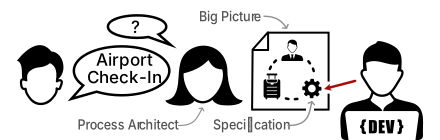
The technology partner receives a process blueprint for context, and collaborates to make it the specification for the implementation of those activities that need digital automation or support.
The workflow is: understand (= describe, share, align) — scope — specify — implement.
The main deliverables are precise, detailed Process Blueprints.
While many industries are in an almost desperate search for high-value AI application, there is little doubt that Large Language Models (LLMs) already provide very real value for software developers.
But what does it mean for the Semantic Eye Framework?
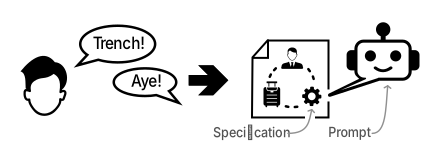
With ever more software generated by AI agents and LLMs, there is an increasing need for the «right» prompts — in any case, if the prompt is wrong, the solution will be wrong.
Process blueprints are the precise, aligned source and context for LLM prompts.
Process blueprints become the focus of digital transformation.

LLMs are so successful in software development because program code is formal language.
Processes are captured as blueprints in semiformal and formal language.
Hence, LLMs can effectively support the creation of process blueprints across all stages — including high-quality software-generation prompts.

Eclipse Theia is the platform on which the Semantic Eye Workbench is built.
It offers first-class LLM support and a framework for the creation of agents.
The Semantic Eye Framework thus comes with world-class AI support right from the start.
The future is bright. So let's adapt to it, not resist it.
The Semantic Eye Framework and its powerful tools are a first, important step.
Find out how the Semantic Eye Framewok saves the digital transformation of your organisation.
.svg)
A nutshell is a very small place: This compact introduction first summarises typical transformation problems, then briefly outlines the framework and the benefits of using it.
4 pages of PDF.
.svg)
This overview document offers a «tour d'horizon» of the framework and its context. It explains where current digital-transformation methodology is flawed, and how organisations can abate the resulting risks by applying the framework.
20 pages of PDF.

A presentation about the problems of digital transformations and a state-of-the-art, open-source tooling solution.
Duration: 45 min.
.svg)
This page provides background on the Semantic Eye initiative and its logo — just in case you wondered why it's a hand and not an eye.
Actually ... it is neither.
2 minute read.